
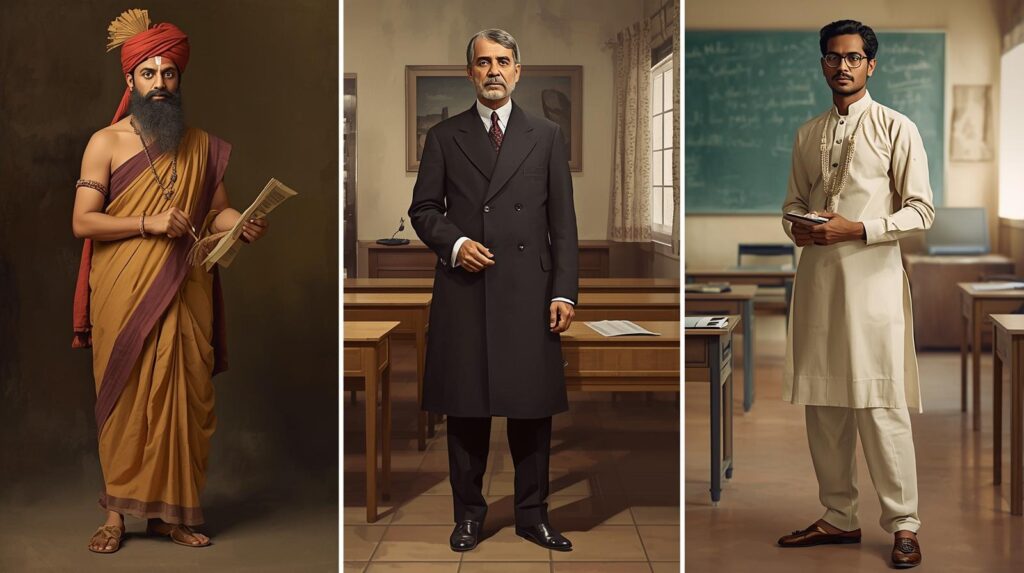
The Sacred Status of Teachers in India
1. Introduction
In Indian tradition, a teacher is not merely an instructor but a Guru—a revered guide who leads the learner from ignorance to enlightenment. The word Guru itself carries deep philosophical meaning: Gu signifies darkness, and Ru signifies light—thus, a Guru is one who removes darkness from life through knowledge and wisdom. This makes teaching in India a sacred duty rather than just a profession.
Unlike the modern idea of education limited to classrooms and examinations, the traditional Indian teacher has always been seen as a path-shower—someone who shapes the student’s intellect, character, discipline, and values. A teacher does not only prepare students for careers but also for life itself. From teaching moral conduct to building self-confidence, the Guru plays a lifelong guiding role in a learner’s journey.
Across Indian society, teachers have historically held a position of immense respect—often equated with parents and even placed above them in spiritual and social hierarchy. Touching the feet of teachers, seeking their blessings, and celebrating their guidance are deep-rooted cultural practices that reflect this reverence. Teachers have been trusted as moral authorities, community leaders, and protectors of knowledge.
Even today, teachers continue to play a decisive role in shaping Indian values, national character, and social identity. They instill ideals such as honesty, discipline, unity, tolerance, and responsibility in young minds. By nurturing enlightened citizens, teachers become the silent architects of India’s cultural continuity and democratic strength.
2. Meaning of a Teacher in Indian Civilization
In Indian civilization, the concept of a teacher is deeply rooted in spirituality, ethics, and the pursuit of truth. The term Guru is not merely a title but a sacred identity. As per Indian philosophy, Gu means darkness and Ru means light—thus, a Guru is one who leads the disciple from ignorance to awareness, from confusion to clarity, and from limitation to enlightenment. This spiritual foundation gives the teacher a status far beyond that of a conventional educator.
The teacher in Indian thought is regarded as the remover of ignorance, which is considered the root cause of all suffering. Knowledge is viewed as the highest form of liberation, and the teacher is the medium through which this liberation becomes possible. Unlike material wealth, knowledge is seen as a divine treasure that grows when shared. Therefore, teaching has traditionally been understood as an act of service, not as a commercial transaction.
In ancient Indian civilization, knowledge was offered with a sense of sacred responsibility. Education was never treated as a commodity but as a sacred duty (dharma). The relationship between teacher and student was built on trust, discipline, devotion, and moral commitment. Students offered guru dakshina not as a fee but as a token of gratitude and respect, reinforcing the spiritual bond between them.
Most importantly, a teacher in Indian civilization has always been a lifelong guide. The role of the Guru did not end with the completion of formal education. The teacher continued to guide the student in moral decisions, social responsibilities, and spiritual growth throughout life. Learning was not confined to classrooms or textbooks; it was a continuous process shaped by real life, values, and experience under the guidance of the teacher.
Thus, in Indian civilization, a teacher is not just a source of information but a torchbearer of wisdom, culture, and righteous living.
3. Role of Teachers in Ancient India
In ancient India, the role of a teacher was central to the entire education system and social structure. Education was imparted through the Gurukul system, where students lived with their teacher in a natural and disciplined environment. This residential system allowed not only academic learning but also the complete development of a student’s character, conduct, and personality. The teacher was not just an educator but a guardian, mentor, and moral authority for the students.
The teacher–student relationship in ancient India was based on deep respect, trust, and lifelong bonding. Students served their Guru with humility and discipline, while the Guru educated them with dedication and compassion. This close association enabled personalized learning, value-based education, and strong emotional and ethical grounding.
Teachers imparted a wide range of knowledge that went far beyond basic academics. Students were trained in:
- Vedas and scriptures, which formed the foundation of spiritual and philosophical understanding
- Science, mathematics, and astronomy, reflecting India’s advanced ancient knowledge systems
- Ethics, discipline, and social duties, which shaped responsible and righteous individuals
Thus, education was holistic—nurturing the mind, body, and soul together.
Teachers in ancient India served as spiritual, moral, and intellectual guides. They were responsible not only for sharpening the intellect of students but also for shaping their character, values, and sense of duty toward society. The Guru guided the disciple in distinguishing right from wrong, truth from falsehood, and duty from desire.
Most importantly, education in ancient India was focused on character building rather than merely career building. The aim was to create enlightened individuals who could contribute positively to family, society, and the nation. Success was not measured by wealth alone but by wisdom, integrity, self-discipline, and service to humanity.
This ancient model of education established the foundation of India’s long-standing respect for teachers and their unmatched role in shaping civilization.
4. Teachers in the Medieval Period of India
During the medieval period, the role of teachers in India continued to be vital in preserving knowledge, culture, and learning, even amid political changes and foreign influences. The traditional Gurukul system gradually evolved into Pathshalas and Madrasas, which became the main centers of education for common people across villages, towns, and cities.
In these institutions, teachers imparted education in a wide range of subjects, including language, literature, philosophy, mathematics, medicine, astronomy, and religious studies. Sanskrit, Persian, Arabic, and regional languages flourished under dedicated teachers who ensured the continuity of India’s rich intellectual heritage.
Teachers during this period played the role of community educators. They were not limited to formal schooling but also guided society through moral teachings, social harmony, and ethical conduct. Village teachers educated children of farmers, artisans, and traders, making education accessible beyond royal courts and elite classes.
Despite periods of invasions and political instability, Indian teachers acted as guardians of knowledge, protecting ancient texts, scriptures, and scientific wisdom. Through handwritten manuscripts and oral traditions, they preserved India’s intellectual legacy for future generations.
The medieval teacher was also instrumental in promoting regional knowledge traditions, folk literature, devotional movements, and social reform ideas. Through their teachings, they kept alive India’s cultural diversity, unity, and learning spirit.
Thus, in the medieval period, teachers served as the bridge between ancient wisdom and emerging social realities, ensuring that education, values, and knowledge remained alive in Indian society despite historical challenges.
5. Teachers During the Freedom Struggle
During India’s freedom struggle, teachers emerged not only as educators but also as nation-builders, reformers, and silent revolutionaries. At a time when the country was under colonial rule, teachers became powerful instruments of social awakening and national consciousness. Schools, colleges, and educational institutions transformed into centers of patriotism, reform, and resistance.
Teachers played a crucial role in spreading the ideas of freedom, self-respect, and national unity among students. Through classrooms, writings, speeches, and personal example, they nurtured a generation of young Indians who were intellectually awakened and emotionally committed to the cause of independence. Education was no longer limited to academic instruction; it became a tool for liberation from mental and political slavery.
Many teachers actively participated in the freedom movement by:
- Promoting nationalist education
- Boycotting colonial institutions and textbooks
- Establishing indigenous schools and learning centers
- Encouraging youth to serve the nation
They instilled values of sacrifice, courage, discipline, and social responsibility in their students, preparing them for a life of service to the motherland.
Teachers also contributed significantly to social reforms during the freedom struggle, fighting against social evils such as illiteracy, caste discrimination, child marriage, and gender inequality. Through education, they empowered people to question injustice and demand dignity and equality.
Most importantly, teachers during this period shaped the moral and ideological foundation of independent India. Their classrooms produced leaders, freedom fighters, administrators, thinkers, and reformers who later played decisive roles in building the nation.
Thus, during the freedom struggle, the teacher was not just a transmitter of knowledge but a torchbearer of national awakening and social transformation—a role that deeply connects teaching with India’s journey toward independence.
6. Role of Teachers in Post-Independence India
After India achieved independence in 1947, the role of teachers became even more crucial in shaping the newly formed nation. The country faced massive challenges such as illiteracy, poverty, social inequality, and lack of skilled manpower. During this transformative period, teachers emerged as the architects of nation-building, carrying the responsibility of educating a diverse and rapidly growing population.
Teachers played a pivotal role in the expansion of the formal education system across urban and rural India. New schools, colleges, universities, and technical institutions were established, and teachers became the backbone of this educational infrastructure. Their efforts significantly contributed to raising literacy levels and creating a foundation for social mobility and economic growth.
In post-independence India, teachers were instrumental in producing:
- Engineers, doctors, scientists, and researchers
- Civil servants, administrators, and policymakers
- Teachers for future generations
- Skilled workers and professionals for national development
Through their dedication, teachers helped build India’s scientific, industrial, medical, and administrative strength.
Teachers also played a powerful role in social transformation. They encouraged equality, democratic values, scientific thinking, and constitutional awareness among students. In villages and small towns, teachers often became community leaders—spreading awareness about health, hygiene, women’s education, and social justice.
With education reaching deeper into rural India, teachers became the bridge between tradition and modernity. They helped students retain cultural values while embracing modern education and global knowledge.
Thus, in post-independence India, the teacher evolved into a social reformer, knowledge-builder, and nation-shaper, guiding the country toward stability, progress, and self-reliance.
7. The Modern Indian Teacher
In today’s fast-changing world, the role of the Indian teacher has expanded far beyond the traditional classroom. The modern Indian teacher is no longer only a source of information but a mentor, counselor, facilitator, and skill developer who prepares students for a highly competitive and technology-driven society.
With the rise of digital education, smart classrooms, and online learning platforms, teachers now use innovative tools such as smart boards, e-learning apps, virtual classrooms, and multimedia resources to make learning more interactive and accessible. The pandemic further highlighted the adaptability of Indian teachers, who quickly embraced digital teaching to ensure continuity in education across urban and rural areas.
Today’s teacher is deeply involved in:
- Skill development and employability training
- Competitive exam preparation
- Career guidance and counseling
- Personality and leadership development
- Innovation, creativity, and critical thinking
The modern Indian teacher is expected to prepare students not only for academic success but also for real-world challenges, entrepreneurship, and global opportunities.
At the same time, teachers continue to carry the responsibility of value-based education. Even in a technology-driven environment, they work to instill discipline, ethical conduct, emotional intelligence, and social responsibility among students.
Balancing tradition with innovation, the modern Indian teacher stands at the crossroads of ancient wisdom and contemporary knowledge, shaping students who are rooted in Indian values yet capable of competing on a global platform.
8. Moral and Social Responsibilities of an Indian Teacher
In India, the responsibility of a teacher extends far beyond academics. A teacher is regarded as a moral guide and social reformer, entrusted with shaping not only intelligent minds but also upright character and responsible citizenship. Society looks to teachers as symbols of integrity, discipline, and ethical conduct.
One of the foremost moral duties of an Indian teacher is to instill strong values such as honesty, compassion, respect, truthfulness, and self-discipline in students. Through daily interactions, personal example, and classroom conduct, teachers deeply influence students’ attitudes, behavior, and life choices.
Indian teachers also play a significant role in promoting social harmony and constitutional values. They educate students about:
- Equality and social justice
- Gender sensitivity and inclusion
- Respect for cultural diversity
- Rights and duties of citizens
By doing so, they help in building a tolerant, democratic, and socially responsible society.
Teachers act as role models in their communities. Their lifestyle, behavior, and dedication often inspire not only students but also parents and society at large. In rural and semi-urban areas, teachers frequently serve as advisors on social issues such as education of the girl child, health awareness, and community development.
Most importantly, teachers nurture a sense of national responsibility and civic duty among students. By encouraging love for the nation, respect for the Constitution, and commitment to social service, they help shape responsible citizens who contribute positively to the country’s progress.
Thus, the moral and social responsibilities of an Indian teacher make the profession one of the most honorable and impactful roles in society.
9. Challenges Faced by Teachers in Present-Day India
Despite their vital role in shaping the nation, teachers in present-day India face numerous challenges that affect both their professional efficiency and personal well-being. The expectations from teachers have increased significantly, but the support systems have not always grown at the same pace.
One of the major challenges is the heavy workload and administrative pressure. In addition to teaching, teachers are often burdened with non-academic duties such as data management, examinations, surveys, election duties, and government reporting. This reduces the time they can dedicate to teaching and student mentoring.
Another serious concern is unequal pay and job insecurity, especially in private institutions and contractual positions. While government teachers enjoy relative stability, many educators in the private sector face low salaries, delayed payments, and lack of social security benefits.
Teachers also struggle with rapid technological changes. The sudden shift toward digital education requires continuous upskilling, access to proper infrastructure, and training. In rural and economically weaker regions, lack of devices, internet connectivity, and technical support becomes a major obstacle for both teachers and students.
Changing student behavior and societal attitudes also pose challenges. Teachers today deal with:
- Increasing academic pressure on students
- Reduced attention spans due to digital distractions
- Lack of discipline and parental support in some cases
- Growing mental health issues among learners
Additionally, many teachers experience mental stress, burnout, and emotional exhaustion due to long working hours, performance pressure, and high expectations from institutions, parents, and society.
Yet, despite these hurdles, Indian teachers continue to perform their duties with dedication, resilience, and commitment—proving that teaching remains a profession driven by service more than comfort.
10. Public Relevance of Teachers in Today’s India
In today’s rapidly transforming India, the relevance of teachers in public life has become more significant than ever. As the nation moves toward a knowledge-based economy, teachers stand at the core of human resource development, shaping the skills, mindset, and values of future generations.
Teachers play a decisive role in building a skilled workforce that supports national missions such as digital transformation, entrepreneurship, and industrial growth. From primary education to higher studies and vocational training, teachers equip students with the competencies required for employment, innovation, and self-reliance.
In rural and underprivileged areas, teachers often become the first agents of social change. By promoting literacy, awareness, and education among marginalized communities, they help break the cycle of poverty and social exclusion. For many families, a teacher is the most trusted guide in matters of education, career, and social upliftment.
Teachers are also central to the success of national development initiatives such as:
- Skill development and youth empowerment
- Digital education and technology adoption
- Women education and empowerment
- Inclusive growth and social equity
During national crises and social challenges, teachers have repeatedly demonstrated their public responsibility—whether through spreading awareness, supporting communities, or ensuring uninterrupted learning.
Above all, teachers help uphold the democratic strength of India by nurturing informed, ethical, and responsible citizens. By shaping public thinking and civic consciousness, they directly influence the quality of leadership, governance, and social harmony in the country.
Thus, the public relevance of teachers in today’s India extends far beyond classrooms—they are pillars of national progress, social stability, and collective growth.
11. Cultural Respect for Teachers in India
In Indian culture, teachers have always been revered with the highest level of respect and honor. The traditional belief places the teacher on a pedestal equal to, and sometimes even above, parents. This deep-rooted reverence is beautifully reflected in the ancient saying: “Guru Brahma, Guru Vishnu, Guru Devo Maheshwara”, which symbolizes the teacher as the creator, preserver, and transformer of knowledge and life.
From ancient times, students have expressed their respect through gestures such as touching the feet of the Guru, seeking blessings, and offering gratitude. These practices symbolize humility, devotion, and recognition of the teacher’s sacred role in shaping one’s life. This cultural tradition continues even today in many parts of India, reflecting the timeless bond between teacher and student.
The celebration of Teacher’s Day is another powerful expression of this cultural respect. On this day, students across the country honor their teachers with affection, appreciation, and gratitude, acknowledging their contribution to personal and national development.
In Indian society, teachers are also seen as moral authorities and trusted community figures. Parents place immense faith in teachers for the intellectual and moral upbringing of their children. In villages and towns, teachers often enjoy a status of dignity and leadership, guiding not just students but entire families and communities.
Even in the modern age of commercialization and fast-paced lifestyles, the cultural respect for teachers in India remains deeply ingrained. A good teacher is remembered for a lifetime, and their influence continues across generations.
Thus, the cultural respect accorded to teachers in India is not merely ceremonial—it is a reflection of the nation’s deep understanding of the transformative power of education and the sacred role of those who impart it.
12. Teacher as a Nation Builder
A teacher is not only a shaper of individual lives but also a builder of the nation. Every strong nation is built on the foundation of quality education, and at the heart of that education stands the teacher. From the classroom to the corridors of power, the influence of a teacher silently shapes the destiny of a country.
Teachers build the nation by creating enlightened, skilled, and responsible citizens. The doctors who save lives, the engineers who build infrastructure, the soldiers who protect borders, the scientists who innovate, and the administrators who govern—all begin their journeys under the guidance of teachers. Thus, every sector of national development carries the unseen signature of a teacher.
Beyond economic development, teachers also shape the moral and democratic fabric of the nation. By instilling values such as honesty, discipline, equality, tolerance, and respect for the Constitution, teachers nurture citizens who strengthen India’s democracy and social harmony. A classroom becomes the first training ground for leadership, responsibility, and civic consciousness.
In rural and underserved regions, teachers often become the true change-makers and social leaders. Through education, they uplift entire communities, reduce social inequalities, and open pathways for countless families to rise above poverty and ignorance.
The impact of a single dedicated teacher can extend across generations. Their words, guidance, and example continue to influence students long after they leave school, creating a ripple effect that shapes society and the nation as a whole.
Thus, a teacher is truly a nation builder in the truest sense—constructing not just careers, but character, consciousness, and the collective future of India.
13. Summary and Way Forward
From the sacred Gurukul tradition of ancient India to the digital classrooms of the modern era, the role of a teacher in Indian civilization has remained timeless and transformative. Across centuries, teachers have served as spiritual guides, moral leaders, social reformers, nation-builders, and architects of India’s intellectual and cultural heritage. They have shaped not only individual lives but also the very identity and progress of the nation.
In every phase of Indian history—ancient, medieval, freedom struggle, post-independence, and modern times—the teacher has stood as a pillar of enlightenment, self-reliance, and social upliftment. Even today, amidst technology, globalization, and rapid change, the essence of teaching remains rooted in service, values, and human connection.
The way forward demands renewed respect, stronger support systems, and better professional recognition for teachers. There is a need for:
- Continuous professional development
- Better infrastructure and digital access
- Emotional and mental well-being support
- Fair compensation and social security
- Greater involvement of teachers in education policy and reforms
To build a strong, self-reliant, and enlightened India, we must first empower those who shape its future—our teachers. When teachers are respected, supported, and strengthened, the nation automatically progresses.
In the truest sense, a teacher is not just an educator of today, but the creator of tomorrow’s India.